





Platform 02 · Infrastructure Watch
Fibre Fault Detection
GAROOD.Optical Fibre Fault Detection System
- Real-Time Monitoring
- Geo-Tagged Alerts
- IoT
- Solar Nodes
- LoRaWAN
- 05
- Modules
- 09
- Capabilities
- 00
- Foreign deps
01Overview
Distributed, real-time fibre health monitoring with GPS-tagged fault and tamper alerts.
Why GAROOD exists.
The problem
Traditional fibre monitoring depends on OTDRs at network endpoints. Testing is periodic rather than continuous, localisation needs skilled technicians, and endpoint-only sensing cannot reliably detect tampering, intrusion, or progressive degradation along remote, contested, or sparsely manned cable corridors.
The GAROOD answer
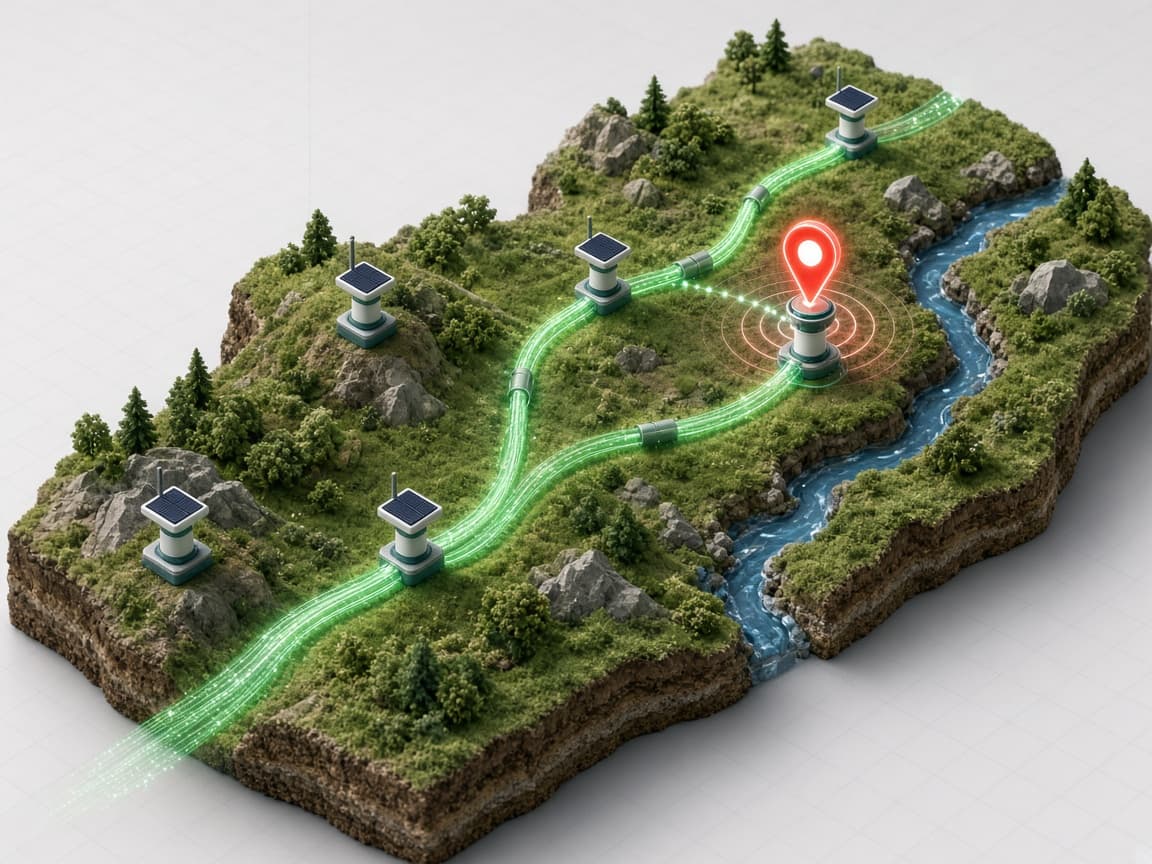
GAROOD places solar-powered monitoring nodes along the fibre route. Each node correlates optical power, environmental, and vibration signals to detect faults and tampering in real time, then raises GPS-tagged alerts that cut Mean Time to Repair (MTTR) for strategic links.
Corridor → fault → GPS tag
GAROOD in action.
01 · Module 01
Field Sensing Nodes
Solar-powered nodes with optical tap sensing, environmental and vibration channels, and local anomaly pre-processing.
02Key capabilities
9 capabilities
What it does in the field.
- 01
Continuous, non-intrusive optical power monitoring via 99:1 tap coupler
- 02
Multi-parameter anomaly correlation — optical, environmental, and vibration
- 03
GPS-based geo-tagged, real-time fault and tamper alerts
- 04
Fully autonomous, solar-powered field node operation
- 05
LoRaWAN long-range wireless backhaul for sparse terrain
- 06
Predictive fault analytics on the operations dashboard
- 07
Scalable from 4-channel prototypes to high core-count routes
- 08
Tamper / intrusion heuristics for contested corridors
- 09
Low-maintenance field design for remote deployments
03Platform modules
5 subsystems
Inside GAROOD.
The major subsystems that make up GAROOD — each deployable inside your perimeter.
Field Sensing Nodes
Solar-powered nodes with optical tap sensing, environmental and vibration channels, and local anomaly pre-processing.
LoRaWAN Mesh / Backhaul
Long-range wireless telemetry suited to corridor and border terrain where fibre or cellular backhaul is unreliable.
Correlation Engine
Fuses optical drop signatures with environmental and vibration patterns to distinguish fibre cuts, bends, and likely physical intrusion.
Ops Dashboard & Alerts
Map-centric console with GPS pins, severity ranking, acknowledgement workflows, and MTTR tracking for NOC / defence communicators.
Predictive Analytics
Trend models that flag progressive degradation before hard failures on strategic spans.
04Deployment
How it deploys.
- Distributed nodes along fibre routes — underground, aerial, or duct-mounted profiles
- Solar + battery autonomy for off-grid corridors
- LoRaWAN gateways feeding a secure on-premise or private ops console
- Scalable channel architecture for multi-core and multi-span networks
- Integrates with existing telecom / defence NOC ticketing where required
05Mission outcomes
What changes.
- Continuous visibility along the full route — not only endpoints
- Faster fault localisation with GPS-tagged alerts
- Lower MTTR on strategic communication links
- Earlier detection of tampering and physical intrusion
- Reduced dependence on periodic OTDR truck-rolls
06Built for
Who runs GAROOD.
- Defence Communication Corridors
- Strategic Fibre Networks
- Telecom Infrastructure Operators
- Critical Communication Backbones
- Border & Remote Corridor Authorities
Explore the stack
Other platforms.
Deploy GAROOD
See GAROOD inside your perimeter.
We'll walk your team through an on-premise GAROOD deployment profile shaped to your network, classification level, and mission.